Critical Raw Materials Research Program (CRM-Research Program)
About Mission for Advancement in High-impact Areas (MAHA) Scheme, ANRF
ANRF, a statutory body of the Government of India, has been established to provide high level strategic direction for research, innovation and entrepreneurship in fields of natural sciences and scientific and technological interfaces of humanities & social sciences to promote, monitor and provide support as required as per recommendations of the National Education Policy.
Mission for Advancement in High-impact Areas (MAHA) is a program under ANRF to support priority-centric, solution-based research in Mission mode focusing at some key areas in alignment with nation's prime requirements. It is envisaged to be multi-disciplinary, multi-institutional and multi-investigator projects with industrial partnerships in the best sorted areas of immediate concern.
ANRF has identified "Critical Raw Materials (CRM)" as a research priority area to include under the MAHA program, which will continue to play a key role in the nation's progress and economic growth as India embarks on the journey of Viksit Bharat 2047.
The MAHA CRM Research Program will be launched in consultation with the National Critical Mineral Mission (NCMM) of the Ministry of Mines. It will be a "limited call" where the Centre of Excellence (COEs), as hubs, recognized by the Ministry of Mines, will be invited to submit proposals in a consortium. The proposals should be structured in a hub-and-spoke model to leverage R&D in critical raw materials and pool the core competencies of each constituent under one umbrella. The spokes can be more open, but hubs are limited.
1. Aim and Objectives of CRM Research program
1.1
AIM OF THE MISSION
The CRM Research Program aims to seed, foster, and nurture scientific and Industrial R&D to create and demonstrate a vibrant, innovative, and agile ecosystem in Critical Raw Materials (CRM) Research in India, driving fundamental understanding and supporting specific technological advances.ANRF will focus on the mission mode outcomes, quality, and impact. The CRM Research Program will help channel substantial funding for R&D through ANRF, utilizing a hub-and-spoke model, where nine COEs, recognized by the Ministry of Mines, should submit their research proposals.
1.2
OBJECTIVES:
2. FOCUSED AREAS OF RESEARCH IN CRM RESEARCH PROGRAM
The following are the focused areas of R&D in critical raw materials, which may lead to technology development and frontier technology's role in mining, extraction, recycling, and processing value chains:
- Focused R&D to reach higher Technology Readiness Levels of TRL 6+in CRM.
- Non-destructive technologies for Critical Mineral Exploration and AI-based exploration Data Processing.
- Critical Mineral Potential Assessment, Resource Estimation, and Multi-Metal Recovery from Mine Waste and Surrounding Host Rocks.
- Beneficiation, process technologies to extract critical raw materials from any feedstock, and recycling.
- Combining the generic processes that are required to process any feedstock that contains critical raw materials and dovetailing it to specific feedstock.
- Reduced metals and specialty chemicals that aid in beneficiation and separation processes.
- Manufacturing of chemicals used in beneficiation and extraction (solvent extraction and ion exchange).
- Process equipment design, development, and fabrication.
- Encourage and engage researchers in the domain of extractive metallurgy;
- AI/ ML tools; AI-ML tools can be used to accelerate the CRM research in order to achieve the proposed goal.
- Any other related area.
3. DURATION AND ELIGIBILITY CRITERIA
3.1
DURATION:
The duration of the project may be maximum up-to three years based on the complexity and nature of the project. However, a further plan for sustainability of the hub/deployment of the developed technologies need to be included.
3.2
ELIGIBILITY CRITERIA AND OTHER DETAILS:
A detailed outline of the eligibility criteria for the consortia members of CRM Research Group is given below:
4.1 Implementation of the project:
- Approval of the research proposal and the grant release are contingent upon the specific project being sanctioned and should be exclusively spent on project-related activities within the stipulated timeframe. The COE (Institute/University) may seek funds or in-kind support from relevant industries (Government, Semi-Government, Autonomous, and Private) for this research project, keeping the ANRF informed about the same.
- The Institute (COE)/ Principal Investigator (PI)/ Co-PI will furnish a Progress Report of the work on the project after attaining the following benchmark in the first 6 (six) months of project implementation:
- Appointment of manpower, providing date of appointment & qualifications.
- Status regarding acquisition of assets sanctioned under the project.
- Status regarding procurement of sanctioned equipment under the capital head.
- The Institute (COE) will not entrust the implementation of the work for which the grant is being sanctioned to another institution, nor will it divert the grant receipts to another Institute as assistance. If the Institute is unable to implement or complete the project, it shall refund to ANRF the entire grant received or the balance of the grant, with interest.
- All the personnel, including Research personnel appointed under the project, for the full/ part duration of the project, are to be treated as temporary employees and will be governed by the administrative rules/ service conditions (for leave, TA/DA, etc) of the implementing Institute.They are not to be treated as employees of the ANRF or the Government of India, nor as permanent employees of the Institute. The ANRF will have no liability what so ever for the project staff after the project duration is completed.
- For the expeditious implementation of the research project,the PI will seek the assistance of the Institute in the process of selecting and appointing sanctioned research personnel/staff, as well as in making payments to them. Scale and emoluments for posts not covered under the ANRF order are governed by the norms prevalent in the implementing Institution or as decided in consultation with ANRF.
- The project becomes operative on the date the Electronic Transfer is received by the implementing Institution (COE).
- If the results of research are to be legally protected, they should not be published without action being taken to secure legal protection for the research findings.
- Any Intellectual Property (IP) generated under the program shall be governed by a joint IP policy developed between ANRF, Ministry of Mines, and the concerned COE, ensuring fair benefit sharing between academia and industry partner.
4.2 Utilization of the Funds:
- The host institute (COE) and the Principal Investigator (PI) must ensure that the funds are used exclusively for the approved research project.
- The host institute (COE) must maintain separate audited accounts for the project. Funds should be kept in an interest-earning bank account, with any accrued interest reported to the ANRF in the Statement of Expenditure (SE) or Utilization Certificate (UC).
- The COE (University/Institute/Organization) will take the responsibilities of submission of all Financial Documents for the disbursement, receiving, and settlement of funds in time as required.
- Anusandhan National Research Foundation (ANRF) is implementing the new TSA hybrid model for fund flow in respect of ANRF Schemes (Scheme Code - 4211). The COE (University/ Institute/Organization) should follow the TSA-SOP available at www.anrfonline.in
- The fund shall not be utilized for the construction of any building unless a specific provision is made for that purpose by ANRF. The host institute is responsible for providing essential infrastructure (accommodation, space, water, electricity, communication, etc.) for the project.
- Any expenditure incurred prior to the issue of the financial sanction and after the expiry of the sanctioned duration of the project will not be admissible.
4.3 Monitoring the Progress of the Project:
- PIs should submit annual progress reports in their specified format through the ANRF online portal.
- In addition to annual reviews, mid-term evaluation may be conducted by the Mission Technical Program Committee (MTPC) to assess translational progress and technology readiness.
- ANRF will periodically monitor the project. The PI should attend the Monitoring Meetings/Workshops to present the progress/outcome of the research project, as and when organized.
- ANRF may designate a specialist or an Expert Panel to visit the host institute to review the progress of the work being carried out and to suggest suitable measures to ensure the realization of the objectives of the project. During the implementation of the project, the Institute will provide all necessary facilities to visiting scientists, specialists, or the Expert Panel, including accommodation, during their visit.
- Proposals should outline expected TRL advancement at the end of each year to demonstrate technology maturity.
- All projects must comply with applicable environmental, safety, and statutory regulations during implementation.
4.4 Release of Next Instalment of Funds:
- At the end of each financial year (FY) and at the time of seeking further instalment of grant, the Institute/PI has to furnish the following documents strictly as per ANRF formats, and upload the same through the ANRF online portal:
- Audited Utilization Certificate (UC), and up-to-date Statement of Expenditure (SE) for the financial year in the correct format.
- Annual/interim progress report, as per approved format.
- List of publications/patents, if any, from the project.
- List of Assets acquired till that Financial Year.
- The release of the next installment of the grant will be contingent upon the submission of financial statements and their acceptance by ANRF.
4.5 Transfer, Extension, and Termination of the Project:
- If the PI/COE HoC/Director wishes to terminate the project, they must inform ANRF immediately, providing proper justification. The host institute (COE) should not incur any expenditure from the date of termination of the project or the date of resignation of the PI, whichever is earlier.
- The PI/COE HoC/Director must seek the consent of ANRF if they intend to be away from the implementing Institute (except for field work related to the project) continuously for a period of more than eight weeks after submitting a proper supportive plan, without disturbing the interest/progress of the project.
- ANRF reserves the right to terminate the project at any stage if it is convinced that (i) appropriate progress is not being made, (ii) the grant has not been utilized properly, or (iii) furnishing of false information or suppression of factual information.
- Transfer of the project from one Institution to another is not allowed as the support is institution-specific (COE).
- The duration of the R&D project will be up to 3 years.
4.6 Settlement of Accounts of the Project:
- The following documents must be uploaded to the ANRF online portal within three months after the completion of the project duration:
- Final Consolidated Statement of Expenditure (SE), giving expenditure financial year-wise (FY) from the date of start till the date of completion.
- Utilization Certificates (FY-wise), matching with Statement of Expenditure figures.
- Project Completion Report (PCR) with a list of publications and patents filed/granted.
- The host institution, with the coordination of the Principal Investigator (PI), is primarily responsible for the timely submission of utilization certificates, statements of expenditure, progress/monitoring reports, the project closure report (PCR), and the refund of any unspent balance at the end or in the event of early closure of the project. If, due to unforeseen circumstances, the PI is unable to settle the project's accounts, the host institution must submit the above documents to ANRF for the proper closure and settlement of the project's accounts.
4.7 Maintenance of Assets Procured Under the Project:
- The host institute (COE) must maintain an audited register of permanent or semi-permanent assets acquired primarily with capital funds, including immovable property and movable capital assets listed in the sanction order. The Institute may be required to send a list of these assets to the ANRF.
- Assets acquired with project funds are considered part of the Institutional Inventory, gifted by the ANRF. They cannot be disposed of or encumbered without prior approval from ANRF. ANRF has the discretion to allow other investigators to utilize the assets for projects sanctioned by ANRF or advise the host institute to transfer them to any other institute if deemed appropriate.
- The Comptroller & Auditor General of India (CAG), at its discretion, shall have the right of access to the books and accounts of the Institute maintained in respect of the fund received from the ANRF.
- The Ministry of Mines has recognized nine Centres of Excellence (COEs), and the list of COEs is given below,
- Indian Institute of Technology (IIT) Bombay
- Indian Institute of Technology (IIT) Hyderabad
- Indian Institute of Technology, Indian School of Mines (ISM), Dhanbad
- Indian Institute of Technology (IIT) Roorkee
- CSIR – Institute of Minerals & Materials Technology (IMMT), Bhubaneswar
- CSIR – National Metallurgical Laboratory (NML), Jamshedpur
- Non-Ferrous Materials Technology Development Center (NFTDC),Hyderabad
- Indian Institute of Science (IISc), Bangalore
- Centre of Materials for Electronics and Technology (CMET), Hyderabad
- The MAHA CRM Research Program will be launched in consultation with the National Critical Mineral Mission (NCMM) of the Ministry of Mines. It will be a “limited call” where nine Centres of Excellence (COEs) recognized by the Ministry of Mines will be invited to submit proposals in a consortium mode. The proposals should be structured in a Hub (COE) & Spoke (other government/private academic institutions) model to leverage R&D in critical raw materials and pool the core competence of each constituent under one umbrella. The spokes can be more open, but hubs are limited. The following diagram explains the structure of COE.
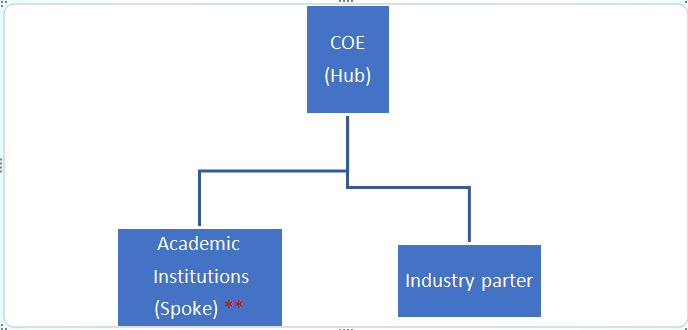
The emphasis will be on bridging the "lab-to-market" gap by ensuring that the technology development process is co-owned by academia and industry, thus facilitating faster adoption and commercialization. - The proposal developed by COE in consortia with industrial partners should include:
- A clearly articulated industry problem statement with a single focus. It should be different for each COE.
- The TRL level (Technology Readiness Level) should be at least TRL 2 (i.e., the COEs should start work from a level of existing maturity.
- The translation pathway for converting research outputs into deployable technologies and COE is responsible for the transition.
- A Letter of Intent from the identified industry partner with a credible and compelling plan for translational research, explicitly mentioning their role, commitment, resources, and interest in co-developing and co-funding (complementary funding) the project proposed by the COE in alignment with the policies of the Ministry of Mines.
- Specific deliverables that are actionable and aligned with national priorities. There should be major milestones (at least one) for each year. Ongoing funding will be based on the achievement of milestones.
- If required, the proposal may include a plan for pilot plants for recovery of critical minerals from secondary sources which will be dealt with Ministry of Mines separately.
- The fund, to be approved per COE (Hub) with spokes, will be based upon evaluation of the proposal, especially the quality of the plan of translation of the R&D, and the necessary co-investments to support that by the industry partner. If this is not satisfactory, those proposals may be deferred (and may be asked to update their proposal) or will not be supported if weak.
- The selection will be based on the recommendations of the Mission Technical Program Committee (MTPC), which is to be constituted by ANRF. If required, the Director/ Head of The Centre (HoC) of COE/Principal Investigator (PI) of the R&D project may be called for discussion/ presentation.
- The Call for applications will be notified through the online portal of ANRF www.anrfonline.in.
- The proposals under the CRM mission should be submitted in online mode only through the website www.anrfonline.in
- Proposals submitted in any mode or platform other than the designated one will not be considered by ANRF
- PI and Co-PI(s) should first register on the official website,click here to register www.anrfonline.in
- After logging in, applicant(s) are required to fill all the mandatory fields in the Profile Detail section.
- Some of the key elements of the proposal should be defined clearly, such as Project Title (max 500 characters), Project summary (max 3000 characters), Keywords (max 6), Objectives of the project (max 1500 characters), Target values being set for the project, Expected output and outcome of the proposal (max 1500 characters).
- Other Technical Details (OTD) of the proposal must be uploaded as a single file in PDF format.
- Document 1: Performa (PI)
- Document 2: Performa (Co-PIs)
- Document 3: Endorsement from PI.Download Template
- Document 4: Endorsement from Co-PIs.Download Template
- Document 5: Certificate from Principal Investigator (PI).Download Template
- Document 6: Certificate from Co-Investigator(s) (PIs).Download Template
- Document 7: Plagiarism Declaration Download Template
- Document 8: Other Technical Details Download Template
Q1: Who can apply under the CRM Research Program?
A1: Only the nine Centres of Excellence (COEs) recognized by the Ministry of Mines are eligible to apply as the Hub. Each COE can submit one consortium-based proposal involving at least two industry partners and two academic or R&D partners (Spokes).
Q2:Can private institutions and industries participate?
A2: Yes. Private academic or R&D institutions with valid UGC/AICTE/DSIR recognition may participate as Spokes. Industry partners are mandatory and must provide a minimum of 10% in-cash contribution and a clear translational research plan.
Q3: What is the expected Technology Readiness Level (TRL)?
A3: Projects should begin at TRL 2 or higher and aim to reach TRL 6 or higher by the end of the project. Each proposal should include a TRL roadmap and a strategy for translation to deployable technology. The explanation for TRL can be found in Annexutre-1.
Q4: What is the funding mechanism and duration?
A4: ANRF Funding: ₹210 Crore (for 9 COEs over 3 years).
Industry Cost Sharing: Minimum 10% in cash.
Project Duration: Up to 3 years.
Funds will be released by ANRF directly to the Hub (COE), which will disburse to its Spokes as per approved participation.
Q5: What are the major deliverables expected?
A5:
- Development of technologies/processes for CRM exploration, extraction, or recycling.
- Pilot-scale demonstration and validation.
- Patents, publications, and potential IP generation.
- Defined annual milestones linked to funding release.
- Translational outcomes enabling lab-to-market progression.
Q6: What are the key documents required for submission?
A6:
- Document1:Performa(PI)
- Document2:Performa(PIs)
- Document3:Endorsement from Hub (COE) and Spoke
- Document4:Certificate from Principal Investigator(PI) and Co-PI from Spoke.
- Document5: Plagiarism Declaration
- Document6:Other Technical Details
- Document7: Full Proposal
- Letter of Intent (LoI) from industry partner(s) with co-funding commitment
- TRL justification and milestone plan
- Sustainability plan after completion of project
Q7: How will proposals be evaluated?
A7: By the Mission Technical Program Committee (MTPC) based on:
- Scientific and technical quality
- Industry linkage and co-funding strength
- Translational and commercialization potential
- Clarity of objectives, deliverables, and milestones
- Capability and track record of consortium members
Q8: Can international collaboration be included?
A8: Yes, for technical or knowledge exchange purposes. However, no ANRF funds will be remitted abroad.
Q9: How will IP rights be managed?
A9: Intellectual Property generated will be governed by IP policy formulated by ANRF.
Q10: What is the submission process?
A10: Proposals must be submitted online only through the ANRF portal: www.anrfonline.in
Submissions through any other mode will not be accepted.
Q11: Can the COE participate as a Spoke in another COE’s proposal?
A11: No, a COE should not participate as a Spoke in another consortium proposal .However, a COE can act as a Hub in only one proposal.
Q12: What are the priority research areas under this call?
A12: The call specifically encourages projects to be aligned with following areas:
- Focused R&D to reach higher Technology Readiness Levels of TRL 6+ in CRM
- Non-destructive technologies for Critical Mineral Exploration and AI-based exploration Data Processing
- Critical Mineral Potential Assessment, Resource Estimation, and Multi-Metal Recovery from Mine Waste and Surrounding Host Rocks.
- Beneficiation, process technologies to extract critical raw materials from any feedstock, and recycling.
- Combining the generic processes that are required to process any feedstock that contains critical raw materials and dovetailing it to specific feedstock.
- Reduced metals and specialty chemicals that aid in beneficiation and separation processes;
- Manufacturing of chemicals used in beneficiation and extraction (solvent extraction and ion exchange);
- Process equipment design, development, and fabrication;
- Encourage and engage researchers in the domain of extractive metallurgy;
- AI/ ML tools; AI-ML tools can be used to accelerate the CRM research in order to achieve the proposed goal.
- Any other related area
Q13: What are the typical project milestones?
A13:
- Material/process synthesis or data acquisition.
- Technology optimization and validation (TRL 3–4).
- Prototype or pilot-scale demonstration (TRL 5–6).
- Technology transfer or commercialization pathway.
Q14: Is overhead cost (institute charges) permissible?
A14: The "Overhead" will be as per the ANRF-OM dated Oct 14, 2024. No budget provision for Capital for the proposals submitted by Spokes. In case of specific requirement, budget under capital may be considered and approved by the competent authority subject to the justification provided.
Q15: How will project monitoring be carried out?
A15: Projects will be monitored by a Joint Review Committee comprising representatives from ANRF, the Ministry of Mines, and domain experts.
Progress will be evaluated biannually against the approved milestones.
Q16: Can existing projects funded by DST/Mines/ANRF be merged or extended?
A16: No. Only new proposals are eligible under this call. However, leveraging existing infrastructure, facilities, or data from ongoing projects is encouraged to strengthen proposals.
Q17: What is a typical funding allocation for each proposal?
A17: The average for each proposal should be 20 Cr (without Pilot Plant) with a maximum outlay of 30 Cr. The average for Pilot Plant should be 10 Cr with a maximum outlay of 15 Cr. There is a 10% (minimum) in-cash cost sharing by Industry Partner. As an example, if a proposal costs 25 Cr and pilot plant costs 15 Cr, then the total cost of project will be 40 Cr where Industry has to contribute 4 Cr. If proposal cost is higher, the industry cost sharing can be more than 10% (in cash or in kind) also.